SAMSKRTACINTANAM
Saṃskṛtacintanam
UGC Care Listed Journal
from January – 2023 to October – 2023
Submission of Papers for
Volume – IX
Open
About
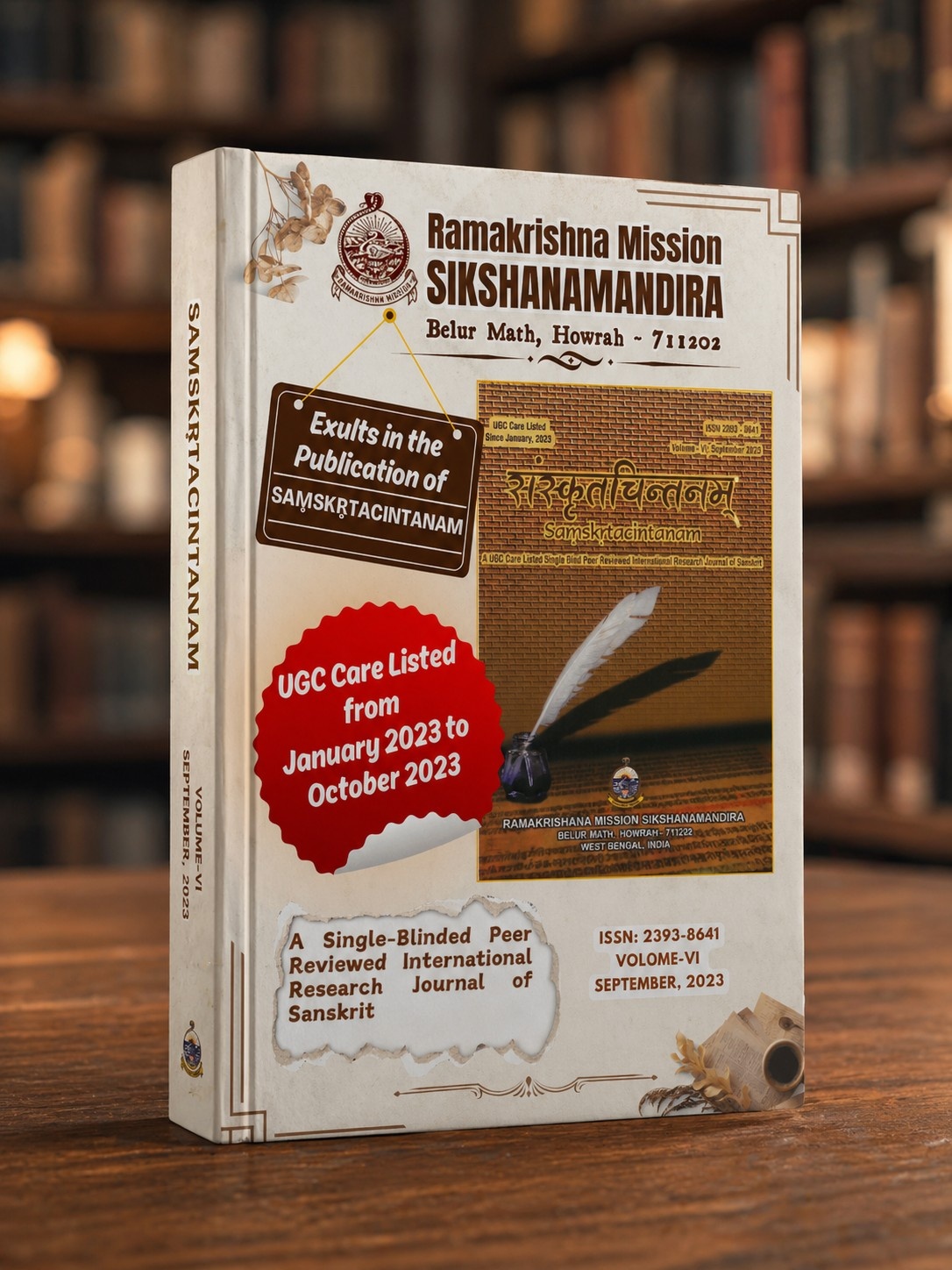
Title:Sam̥skr̥tacintanam (UGC Care Listed Journal)
Frequency:Annual
Publication Month:December
ISSN:2393-8641
Journal Type:Single-Blinded Peer Reviewed International Research Journal of Sanskrit
Publisher:Ramakrishna Mission Sikshanamandira
Editor:Sri Somen Dutta, Assistant Professor, Ramakrishna Mission Sikshanamandira, Belur Math
Copyright:The Secretary, Ramakrishna Mission Sikshanamandira
Year of Inception:2014
Subject:Sanskrit
Language:Sanskrit, English
Publication Format:Print
Email:samskritachintanam[at]rkmsm[dot]org
Website:https://rkmsm.org/
Address:Belur Math, Howrah - 711 202, West Bengal, INDIA
Since 2014, the College has annually published Saṃskṛtacintanam (ISSN: 2393-8641), a single-blind, peer-reviewed international research journal of Sanskrit. This collection offers diverse and lucid expositions resulting from continuous research and innovation. By treating Sanskrit as both a heritage language and a dynamic cultural force, these papers provide authoritative insights for educators, researchers, and policymakers to explore the language and its literature. he journal is dedicated to publishing original, high-quality scholarly research articles that contribute to the advancement of knowledge in the field of Sanskrit. The journal particularly encourages studies that address the long philosophical and grammatical traditions of Sanskrit that have continued with undiminished vigour into the present century. The journal welcomes submissions from researchers, teacher educators, academicians, policymakers, and practitioners from across India and the world.
Aims & Scope
Aims
“Sanskrit and Prestige go hand in hand”- Swami Vivekananda (Swami Pavitrananda, 1947). He envisioned an India where every individual possessed adequate knowledge of this glorious language, so that the entire nation could become proficient in Sanskrit. He had great sympathy for the promotion of this language in India. By providing a scholarly platform for interdisciplinary dialogue and critical reflection, Saṃskṛtacintanam upholds Sanskrit as a grammatically intricate classical language that serves as a rich backdrop to India’s pristine cultural heritage.
Scope
Saṃskṛtacintanam embraces a broad and dynamic scope that reflects both the classical depth and contemporary relevance of Sanskrit studies. Inspired by the educational ideals of Swami Vivekananda and the academic vision of Ramakrishna Mission Sikshanamandira, the journal encourages research spanning Vedic, classical, and modern Sanskrit literature, philosophical systems, grammar, manuscriptology, and allied disciplines such as Ayurveda, linguistics, and cultural studies. It also promotes interdisciplinary inquiries that connect Sanskrit knowledge traditions with modern fields, including education, environmental studies, artificial intelligence, and Indian Knowledge System (IKS).
Areas of Interest
- Alankara Shastra
- Ayurveda Shastra
- Classical Literature
- Grammar
- Itihasa and Puranas
- Linguistics
- Manuscriptology
- Modern Literature
- Philosophical Systems
- Technological Advancement
- Vedic Literature
Published Volumes
(ISSN 2393-8641) Vol-8 DOI : 10.5281/zenodo.18755165
(ISSN 2393-8641) Vol-7 DOI : 10.5281/zenodo.15295173
(ISSN 2393-8641) Vol-5 DOI : 10.5281/zenodo.7840300
(ISSN 2393-8641) Vol-4 DOI : 10.5281/zenodo.7840286
(ISSN 2393-8641) Vol-3 DOI : 10.5281/zenodo.7840260
(ISSN 2393-8641) Vol-2 DOI : 10.5281/zenodo.7935354
(ISSN 2393-8641) Vol-1 DOI : 10.5281/zenodo.7840194
For further queries, please contact
samskritachintanam[at]rkmsm[dot]org